
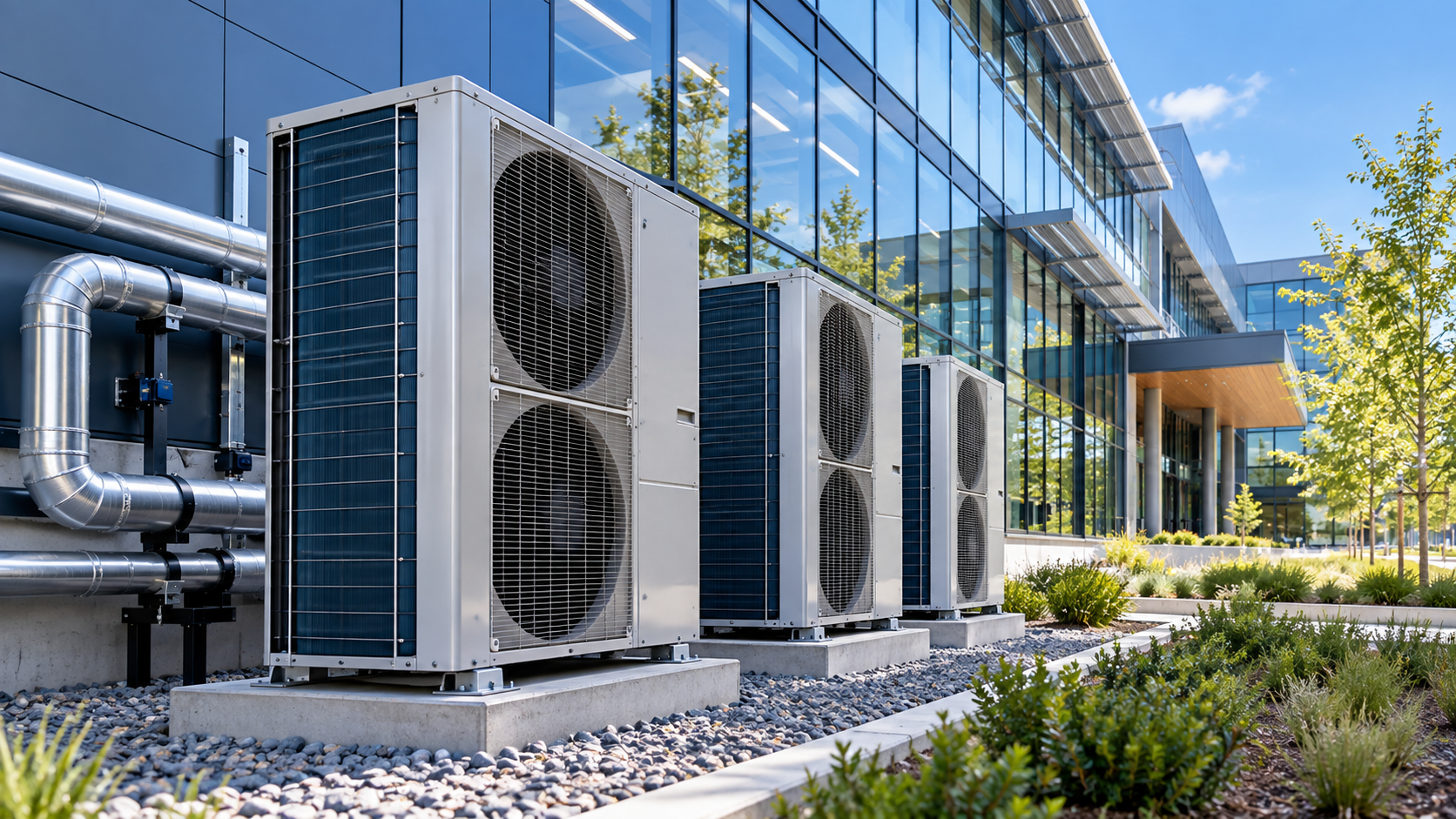
Replacing a boiler with a heat pump is not simply an equipment swap. The water temperature at which radiators, fan coils, pipework and controls can meet the building load largely determines comfort, efficiency and operating cost.
1. Why water temperature matters
A heat pump moves energy from a low-temperature source to a warmer heating circuit. A larger temperature lift makes the compressor work harder. Outdoor temperature and water temperature must therefore be assessed together, rather than relying on one catalogue COP value.
A COP of 4.0 means that roughly 4 kWh of heat is delivered for 1 kWh of electricity at that operating point. Seasonal results also reflect weather, defrost, pumps, auxiliary heat and part-load operation.
2. Correct survey sequence
- Calculate room-by-room design heat loss.
- Record every radiator, fan coil and underfloor circuit.
- Determine emitter output at candidate water temperatures from manufacturer data.
- Check flow, pipe sizes, pressure loss, pumps, valves and balancing.
- Match capacity and COP at actual outdoor-air/water operating points.
Historic fuel use is a useful cross-check, but it is not a substitute for a design calculation.
3. Emitter output at lower temperature
Output falls as the difference between mean water temperature and room temperature falls. For preliminary assessment:
A radiator rated at 2,000 W at 75/65 °C in a 20 °C room has a reference ΔT of 50 K. At 45/40 °C, ΔT is 22.5 K. Using an indicative exponent of 1.3, output falls to about 710 W. Final selection must use manufacturer data.
| Emitter | Behaviour | Check |
|---|---|---|
| Underfloor heating | Large area suits low temperature | Spacing, finish, surface limit |
| Large radiator | Can work at moderate temperatures | Corrected room output |
| Fan coil | Fan supports low-temperature output | Coil, acoustics, condensate |
| Small legacy radiator | Output may fall sharply | Enlarge or reduce heat loss |
4. Flow, pipes and pumps
Moving 10 kW at a 5 K difference requires about 1.72 m³/h; at 10 K it requires 0.86 m³/h. Higher flow can increase velocity, noise and pressure loss. Verify pipework, strainers, valves and pump duty.
Maintain minimum flow, but add hydraulic separation or buffer volume only for a defined requirement. Unnecessary mixing can raise temperature and reduce efficiency.
5. Weather compensation
The system should not run all season at the coldest-hour temperature. Weather compensation reduces flow temperature in milder weather. Set the curve from calculated design points and tune it with measurements. Check flow, balancing, filters and valves before raising the curve. Frequent cycling calls for review of minimum output, zoning, water volume and thermostat logic.
6. Treat domestic hot water separately
Domestic hot water has distinct storage, hygiene and scalding requirements. Coordinate cylinder coil size, storage temperature, hygiene cycles, auxiliary heat and outlet mixing protection.
7. Practical decision matrix
| Finding | First response | Verify |
|---|---|---|
| A few rooms are short | Upgrade critical emitters | Balancing and valves |
| Whole-building load is high | Assess fabric improvements | Recalculate heat loss |
| Pipes cannot carry flow | Split circuits or upgrade runs | Pump duty and noise |
| Extreme-weather gap | Evaluate a bivalent source | Changeover temperature |
| Frequent cycling | Review minimum output, zones and volume | Controls and sensors |
8. Commissioning and monitoring
Measure design flows, clean strainers, vent the system and verify sensors. Monitor outdoor, flow, return and room temperatures with electrical input and heat output where possible. Defrost frequency, auxiliary-heater hours and compressor starts reveal problems early.
9. Common mistakes
- Sizing from the old boiler nameplate.
- Treating one catalogue COP as annual performance.
- Ignoring emitter output at lower temperature.
- Ignoring flow effects on pipes and pumps.
- Disabling weather compensation.
- Leaving electrical capacity and auxiliary heat until the end.
10. Conclusion
A successful retrofit heats the building at the lowest practical water temperature. Heat loss, emitters, flow, pipework and controls belong to one calculation chain.
MCS Heat Pump Guide · U.S. DOE Better Buildings · UK Home Energy Model
For education and preliminary design. Apply current regulations, standards, manufacturer data and qualified engineering review.